he five categories of software every modern oil & gas production accounting team needs — and the platforms worth evaluating in each.


If you’ve ever been a production accountant in oil and gas, you know the job is less “accounting” and more “make 14 systems agree with each other before close.” Volumes from one place, invoices from another, owner decks from somewhere else, and a JIB statement that always seems to be off by a few dollars no matter how many times you check it.
The tooling has finally caught up to the work. The catch is that most vendors want to sell you a full ERP, and most teams don’t actually need one. What you need is five specific things that work — and that talk to each other.
Here’s the short list, with the platforms actually worth evaluating in each category.
This is the foundation of the job. Daily and monthly oil, gas, water, and NGL allocations per well. Tank gauges, meter reads, well tests, sales tickets, and the inevitable reconciliation between produced and sold volumes. If your “system” for this is a tab in a shared spreadsheet, you already know how the rest of the month is going to go.
A purpose-built production system handles multi-tier allocations, models your gathering network, and pulls data straight from SCADA or field data capture so your accountants aren’t re-keying hand-written tickets.
The big-operator default. Multi-tier date-effective allocations on a real flow-network model that mirrors your physical gathering system. ProdView Go captures volumes, measurement data, safety events, and emissions offline and syncs back when there’s signal — useful for remote pads.
Centralizes daily production data from SCADA, field data capture tools, and measurement platforms into a governed system of record. Built-in validation rules flag out-of-balance days and missing data so you’re catching problems on the day they happen, not on close day.
A hydrocarbon accounting platform that models your production infrastructure (wells, meters, tanks, gathering equipment) as interconnected objects. Strong fit for operators with complex commingled facilities and rigorous regulatory reporting needs.
Graphical delivery system interfaces, daily estimates, monthly volume allocations, AFE management, morning reports, and wellbore schematics in one platform. Good fit for mid-size operators who want production tightly coupled to land and accounting in the same suite.
Allocation scenarios configurable by days on, percentage, flat amount, volumes, wells, or product. The pragmatic choice for independents already running PakEnergy on the accounting side who want production in the same stack.
Built for small operators who don’t have IT and don’t want a six-month implementation. Multi-well facilities, commingled production, and allocation calculations are built in. Mobile-first; field hands enter volumes on a phone.
For most production accounting teams, AP is the single biggest time sink that has nothing to do with production. Invoices arrive as PDFs (often bundled, often with line items that need to be split across multiple wells, AFEs, and GL accounts), someone has to figure out the right coding, route it for approval, and get it into the books before close.
Traditional AP automation tools were built for office expenses, not oilfield invoices. They’re great at reading a vendor name and a total. They’re not great at knowing that “frac sand on Pad 14B” should be coded as IDC against AFE 2026-031 with the specific well allocation pulled from your division of interest.
This is where AI-native AP tools have changed the game. They learn your chart of accounts, your AFE structure, and your well list, then code line-by-line with the context an oilfield invoice actually requires.
Purpose-built for oil and gas. AI codes line-by-line to the right GL account, AFE, well, and cost code. Splits bundled multi-invoice PDFs in a click. Works with whatever accounting system your team is on. (Yes, this is us — we’ll keep it factual; full breakdown below.)
A long-established e-invoicing network in O&G with vendor adoption that’s hard to match. Configure auto-coding and auto-approvals against threshold rules. Integrates with 25+ ERPs and accounting systems used in oil and gas. Often the default if you have a large supplier network and want them all on one portal.
Built for project-driven industries including oil and gas. Captures invoices and codes costs directly to wells, AFEs, and cost centers without manual rekeying. Newer entrant; lighter weight than enterprise options.
General-purpose AP automation with a built-in AI assistant (“Billy”) that extracts data, suggests GL coding, identifies duplicates, and routes for approval. Has an OGsys integration if you’re on that ERP. Best for teams that want a polished general AP product and can live without the deeper oilfield-specific coding.
AI-powered AP automation built into the IFS stack. Makes sense if you’re already on IFS Merrick or IFS Cloud — otherwise the integration overhead probably isn’t worth it.
Enterprise-grade AP automation with strong upstream and midstream credentials. Compliance and visibility are the headline features. Heavier than the AI-first options on this list and priced accordingly.
The honest answer is that any of these will outperform manual coding — pick the one that fits your ERP and the size of your supplier network.
The other side of the close: every month, you owe royalty owners and working-interest partners a check and a statement that explains it. The math is straightforward in theory and miserable in practice — date-effective decks, multiple severance tax regimes, deductions, suspense, prior-period adjustments, the whole bit.
Doing this in Excel works until it doesn’t, and “doesn’t” usually arrives at the same time as a payee phone call asking why their check is short $14.62.
A real revenue distribution system handles complex DOI decks, generates the owner statement and the JIB in the same run, calculates severance and ad valorem correctly per state, and gives you an audit trail when an owner inevitably calls.
Handles JIB, revenue distribution, and division orders in one cloud platform with production data wired directly to financials, so revenue calculations update automatically as volumes change. Six-figure implementations are the norm; built for operators with 500+ wells and dedicated IT.
One of the top three most commonly run revenue distribution platforms among independents. Calculates owner payments, generates statements, and ties cleanly into the rest of the PakEnergy accounting suite. Strong land and lease integration.
Manages allocation and payment of oil and gas revenues across complex ownership structures, with date-effective and scaled DOI decks. A strong pick for operators with messy ownership histories where prior-period adjustments are routine.
Cloud platform for upstream producers that automatically computes and allocates revenue and expense distributions as purchase statements and invoices are recorded. Newer; designed to feel modern compared to the legacy options.
Solves a slightly different problem: when the workflow starts with someone else’s revenue statement (you’re the non-op, or you’re tracking what an operator paid you), Joltly ingests the PDF and turns it into a live, filterable dashboard without re-keying.
JIB is the single most “oil-and-gas” thing about oil-and-gas accounting. Every operator with non-op partners has to bill them their working-interest share of well costs every month, and every non-op has to verify the bill they got is actually right. Both sides hate it.
The right JIB software handles cost allocation by working interest, generates the partner statements, supports your COPAS pricing schedules, and ideally flows data both ways so you’re not emailing PDFs around. For operators with a lot of partners, this is a multi-day exercise that good software cuts to hours.
One of the top three most commonly run accounting platforms among independents. Full JIB and revenue distribution workflow, strong land management integration, and a big partner ecosystem of CPA firms that already know it. The default-pick for independents who want a proven full-suite option.
End-to-end production accounting, allocation, royalties, and revenue distribution including JIB, with deep integration to SCADA and ERPs. Aimed at operators with hundreds of wells and a dedicated accounting team.
Built for operators managing complex multi-entity structures. Real-time JIB reconciliation lets you track cost allocations across partners as transactions happen, instead of finding mismatches at month-end.
User-friendly joint-venture accounting that’s accessible without a steep learning curve. Handles cost allocation, partner billing, and joint-venture reporting with enough depth for most small to mid-sized operators. Strong pick if your team is small and you don’t want to spend six months learning the software.
Highly flexible JIB system that simplifies categorizing costs across well classifications, distributes costs among working-interest owners, and generates partner invoices. Good fit if you already run Enertia for the rest of your accounting.
This one quietly has more leverage than people realize. If your owner relations team spends half its day answering “did my check go out?” calls or emailing replacement statements, you have a portal problem, not a staffing problem.
A good portal lets owners and partners log in, see their statements (revenue, JIB, payout, 1099), update their address, switch to ACH, and download history. Every one of those self-service actions is one fewer phone call your team has to answer.
For operators with a lot of working-interest partners and a long royalty owner list, this is genuinely the highest ROI tool in the stack.
The dominant portal in the industry. Owners and working-interest partners get 24/7 self-service access to monthly statements, revenue check detail, 1099s, JIBs, payout statements, ACH electronic deposit setup, and change of address. Most owners with multiple operator relationships are already used to logging into EnergyLink — there’s a real “familiar UX” advantage.
If you’re already on Quorum On Demand, the bundled owner portal keeps everything in one stack with one set of credentials. Fewer integrations to manage; less reach than EnergyLink with cross-operator owners.
Same logic as Quorum’s: bundled with PakEnergy’s accounting suite, smooth if you’re already on it. The trade-off is whether your owners would prefer a portal they already know (likely EnergyLink) or one tied tightly to your stack.
Some operators build their own owner portal on top of their accounting system. Higher upfront cost; pays off for operators with a strong brand relationship to their owner base or unique workflows that off-the-shelf portals don’t handle.
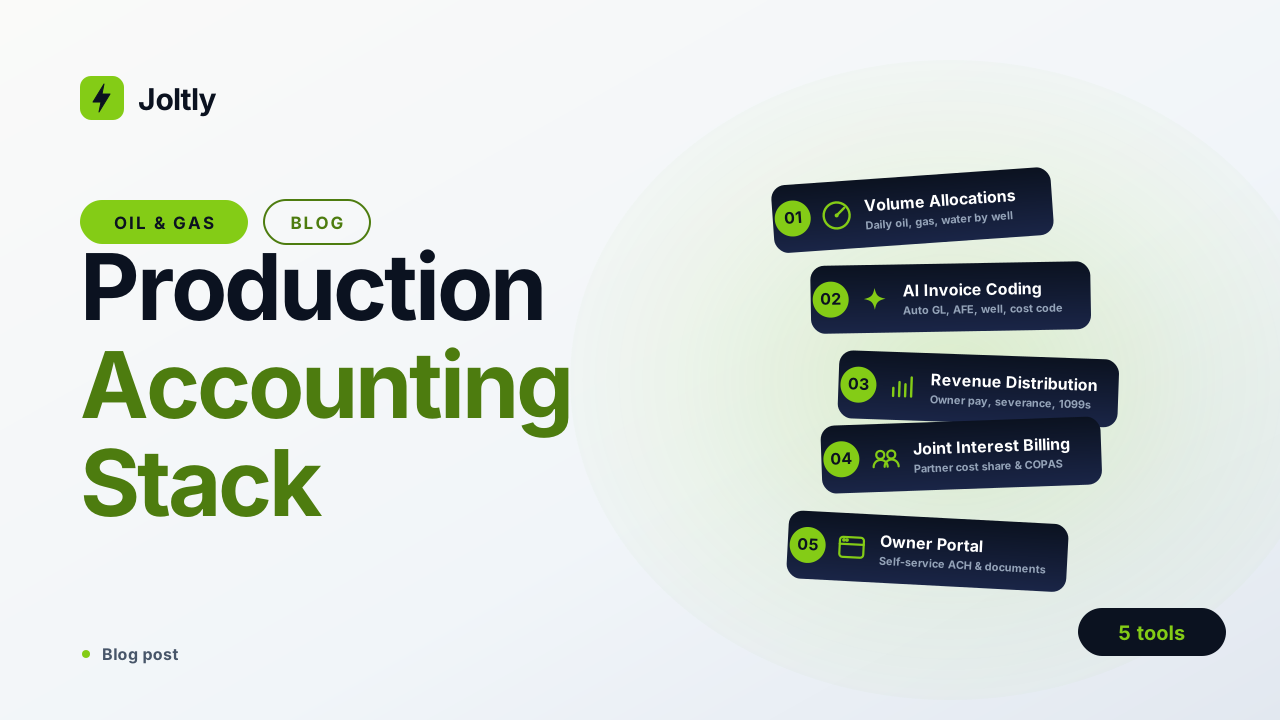
If you look at this list, it’s basically the production accountant’s job, broken into the five places software actually saves time:
You don’t have to buy all five from the same vendor. In fact, most teams that try to do that end up paying for an enterprise platform that does three things well and two things badly. The modern stack is more modular: a real production system, a best-in-class AP/coding tool, a revenue distribution platform that can talk to it, and a portal layer on top.
We’re the AI-powered AP and invoice automation layer built specifically for oil & gas operators. Generic AP tools were built for office expenses; we built Joltly because invoices in this industry need to know about wells, AFEs, IDC vs. LOE, and joint interest splits — and they need to land in your accounting system without re-keying. Three things we do that the other tools on this list don’t do as well:
One bundled multi-invoice PDF becomes 8 separate invoices in a click. Each split shows its own total before you commit.
Codes line-by-line to the right GL account, AFE, well, and cost code — learning your chart of accounts and well list as it goes.
Ingest external owner revenue statements (the kind you get as a non-op) and turn them into a live, filterable dashboard without re-keying.
Get quick answers to common queries in our FAQs.


You only pay for what you use — no seat fees and no modules you don't need. Pricing is a monthly platform fee plus usage on documents processed, ACH payments, mailed checks, and the workflows you turn on. We size it to your actual monthly close so it scales with the work, not your headcount.
A smaller operator running 25 documents, 10 ACH payments, and 2 mailed checks a month would be priced on that exact volume. A larger operator at 100 documents, 50 ACH payments, and 10 checks pays predictably more. You always know what you're spending because it tracks the actual close.
Joltly connects directly to QuickBooks and Quorum On-Demand Accounting, and supports file-based export workflows for systems like PakEnergy and Integra. It manages accounts, items, vendors, partner mappings, JIB clearing, revenue liabilities, and netting accounts inside your existing setup.
Both sides of settlement. On expenses: invoice review, GL coding, approvals, JIB creation, ACH and check payments. On revenue: statement OCR, partner distributions, remittance emails, and netting between JIB receivables and revenue payouts — so your team replaces spreadsheet work and email follow-up during close.
Yes. Your wells, partners, revenue interests, GL mappings, approval flow, export formats, and partner-facing statements are configured per operator. Most customers go live on their existing chart of accounts and ERP setup — no rebuild required.
Faster than most teams expect. Your AP workflow can be live in less than a week — and you don't need to change your current accounting system. Revenue typically takes about two weeks. The only thing we need from you is a sample revenue statement so we can train the AI on your format.
We set up a Microsoft Teams channel or email channel for your team — whichever you prefer. You'll also get the founders' phone numbers for text messaging when you need a fast answer.