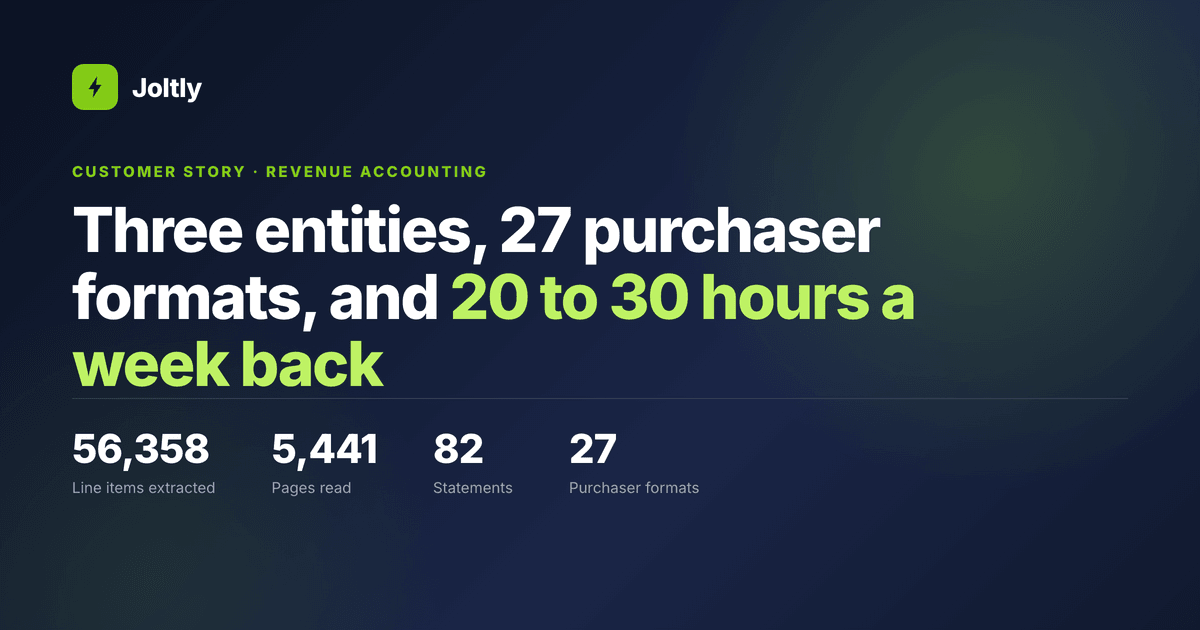
How one small team runs revenue accounting for three non-operated entities across 27 purchaser formats, and what four months of production data says about the 20 to 30 hours a week Joltly gives back.


One month, a revenue statement lands that runs 835 pages. Inside it are 9,316 line items, each one a well, a product, a production month, a volume, a price, and an owner interest carried out to six decimal places. The same week, another purchaser sends a statement that is one page long and contains a single line.
Both have to be posted. That is the actual shape of non-operated revenue accounting, and it is why staffing it has always been hard. The work does not arrive evenly. It arrives in waves.
“Sometimes an operator will post an 800 page statement one month with a million adjustments, versus the following month it’ll only be 20 pages.”
That is Elle Ross, Controller of Spearpoint Resources, an oil and gas company with multiple entities holding non-op assets. Three entities, twenty-seven purchaser formats, and until recently, all of it posted by hand. Her estimate of what Joltly gives back: 20 to 30 hours a week. In her words, “not quite a full time person, but almost.” That time goes straight back into the work only her team can do. “This gives our staff time back that can be allocated to troubleshooting issues, analysis, reporting, and supporting A&D activity.”
What follows is the production data behind that number.
Across three entities, 27 distinct purchasers each send their own layout. One is a single page with a single line. Another runs 835 pages.
Every line is pulled out at well and lease level with volumes, prices, interests, taxes and deductions, and grounded back to its coordinates on the source page.
The output lands in the format WolfePak already expects. No migration, no second set of books.
These are real figures from the three entities running revenue through Joltly, from go-live in May 2026 through the end of August.
Split by entity, the shape of the problem is not what you would guess from the size of the checks.
| Entity | Statements | Line items | Pages | Purchasers |
|---|---|---|---|---|
| OpCo 1 | 40 | 6,471 | 839 | 15 |
| OpCo 2 | 30 | 43,964 | 3,799 | 11 |
| OpCo 3 | 12 | 5,923 | 803 | 4 |
OpCo 1 files the most statements and produces the fewest line items. OpCo 3 files the fewest statements and carries by far the most revenue. OpCo 2 sits in the middle on statement count and generates seven times the line-item volume of either. There is no single number that tells you how much work an entity represents, which is why the workload has to be planned from line count rather than from entity count.
“Revenue statement” is one phrase covering wildly different documents. These are five real statements from the same book, at opposite ends of the range.
| Statement profile | Pages | Line items | Wells | Production months |
|---|---|---|---|---|
| Largest in the book | 835 | 9,316 | 43 | 11 |
| Deepest prior-period catch-up | 690 | 7,436 | 46 | 21 |
| Densest per page | 222 | 4,577 | 96 | 9 |
| Median statement | 29 | 227 | — | — |
| Smallest in the book | 1 | 1 | 1 | 1 |
The largest statement is 835 times the smallest by page count and 9,316 times the smallest by line items. Eighteen of the eighty-two statements are five pages or fewer. Fourteen run past a hundred pages.
The second row is the one worth sitting with. That statement is 690 pages covering 21 separate production months, meaning a single check settles up nearly two years of prior periods across 46 wells. Every one of those lines has to land in the right period. The third row is the opposite failure mode, a statement that is not especially long but carries 96 wells, so the detail is packed rather than spread out.
A template built for any one of these does not survive contact with the next one. That is the reason this work stayed manual for as long as it did.
This is the part Elle called out on her own, before we showed her any of it. Here is the same three-entity book, month by month, as the statements were worked.
| Month | Statements | Line items | Change vs. prior |
|---|---|---|---|
| May 2026 | 3 | 249 | Go-live |
| June 2026 | 17 | 1,435 | 5.8x |
| July 2026 | 16 | 35,764 | 24.9x |
| August 2026 | 46 | 18,910 | 0.5x |
Look at July against August. August brought nearly three times as many statements and roughly half the line items. Statement count tells you nothing. Page count tells you a little. Only line count tells you what the month is going to cost you, and you find that out after the PDF is already open.
A manual process cannot be sized against that. Plan the week around June and July does not close on time. Plan it around July and the same effort is spent on a month that did not need it. That is the problem Elle described, and it is the one the data shows.
“Joltly helps us normalize the total time spent posting revenue, giving the accounting team a more consistent workload and time allocation.”
A non-operated working interest is usually a small fraction of a large well. The operator sells the production, takes out taxes and deductions, and sends a statement showing your slice. The slice can be a rounding error. The statement showing it is not.
A 0.4% interest in 200 wells produces the same number of rows as a 40% interest in 200 wells. Both of them require the same keystrokes. One requires extreme efficiency with G&A spend; one does not.
Operators true up months and years after the fact. A single check can carry line items spanning dozens of production months, each needing to land in the right period.
When a handful of wells come online at once, the first statement can carry six months of production instead of one. The month that happens does not look like any other month.
Acquiring interests adds statements permanently. Hand entry puts a ceiling on how many deals a back office can absorb, and that ceiling arrives long before the economics say it should.
Upload the PDF, or forward the email. No pre-sorting, no splitting, no renaming, and no separate template per purchaser.
Well, lease, product, production date, volume, price, owner interest, gross and net value, taxes and deductions. The full detail, not a summary total.
Each extracted figure keeps its coordinates on the source PDF, so checking a number means clicking it and seeing it highlighted on the original page.
Review the exceptions rather than the whole file, then export in the format WolfePak expects and post it.
We asked Elle for a rough estimate of what Joltly saves across the three entities. We did not give her a number to react to.
The hours matter, but the second half of that answer is the real result. Twenty to thirty hours a week is what it costs to keep up in an average month. The harder problem was never the average. It was that no month is average, and the peaks are the ones that push a close past the deadline.
Line-level detail is now captured more efficiently, and Elle’s team carries three entities and twenty-seven purchaser formats with peak volume months not exacerbating the team’s workload. The next acquisition does not have to come with a hiring conversation attached.
An oil and gas company with multiple entities holding non-op assets, with positions across multiple operators and basins and revenue accounting for all three entities run by one small team. Live on Joltly since May 2026, with output exported into WolfePak.
If you have an 800-page PDF that takes a week to work through, that is the one we want to see. We take any revenue statement and give it back to you in a format you can import into any accounting system.
Get quick answers to common queries in our FAQs.


You only pay for what you use — no seat fees and no modules you don't need. Pricing is a monthly platform fee plus usage on documents processed, ACH payments, mailed checks, and the workflows you turn on. We size it to your actual monthly close so it scales with the work, not your headcount.
A smaller operator running 25 documents, 10 ACH payments, and 2 mailed checks a month would be priced on that exact volume. A larger operator at 100 documents, 50 ACH payments, and 10 checks pays predictably more. You always know what you're spending because it tracks the actual close.
Joltly connects directly to QuickBooks and Quorum On-Demand Accounting, and supports file-based export workflows for systems like PakEnergy and Integra. It manages accounts, items, vendors, partner mappings, JIB clearing, revenue liabilities, and netting accounts inside your existing setup.
Both sides of settlement. On expenses: invoice review, GL coding, approvals, JIB creation, ACH and check payments. On revenue: statement OCR, partner distributions, remittance emails, and netting between JIB receivables and revenue payouts — so your team replaces spreadsheet work and email follow-up during close.
Yes. Your wells, partners, revenue interests, GL mappings, approval flow, export formats, and partner-facing statements are configured per operator. Most customers go live on their existing chart of accounts and ERP setup — no rebuild required.
Faster than most teams expect. Your AP workflow can be live in less than a week — and you don't need to change your current accounting system. Revenue typically takes about two weeks. The only thing we need from you is a sample revenue statement so we can train the AI on your format.
We set up a Microsoft Teams channel or email channel for your team — whichever you prefer. You'll also get the founders' phone numbers for text messaging when you need a fast answer.