An operator's back office moves money in three different directions every month — vendor AP, owner revenue distribution, and JIB to and from partners. Here's why those flows belong in one place, and how Joltly is closing the loop.
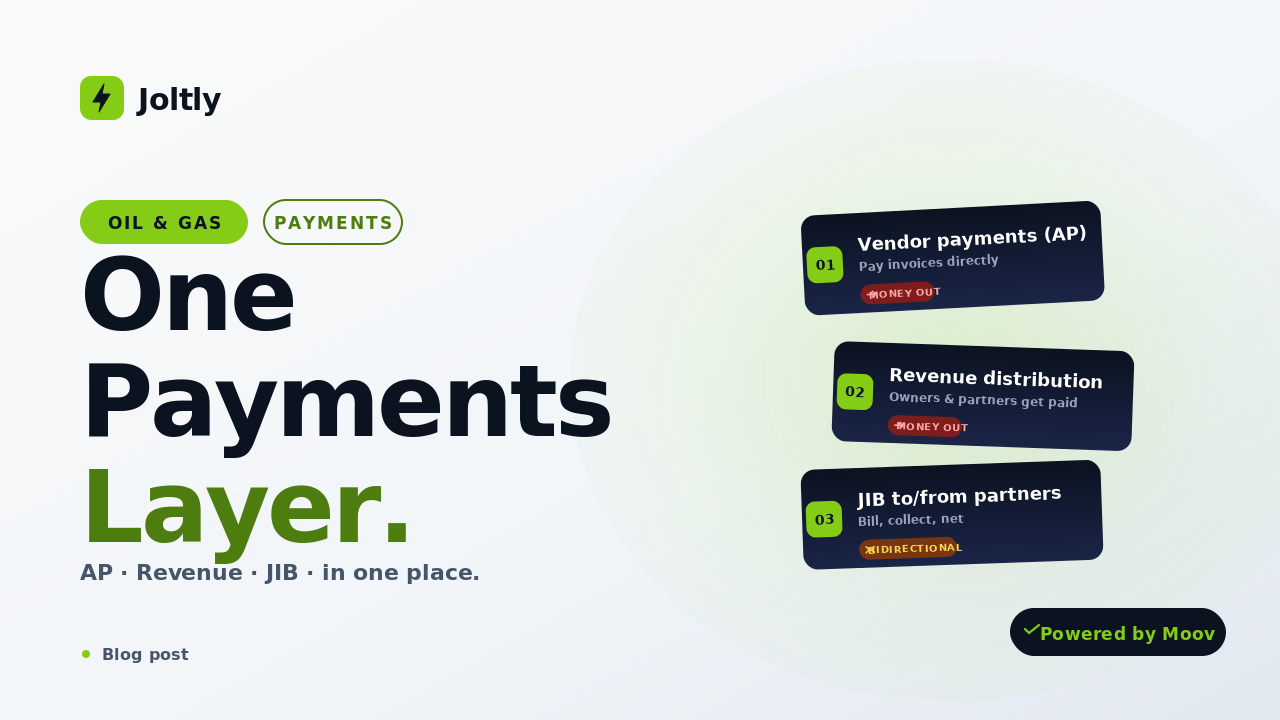


In a typical month, the back office of a mid-sized oil and gas operator moves money in three different directions, through three different systems, and reconciles each one separately. Vendor invoices get approved in an AP tool, then paid through a bank portal. Royalty owners and working-interest partners get statements generated in the accounting system, then paid via an exported ACH file. Joint-interest partners get billed for their share of well costs through a JIB workflow, then chase the operator for ACH instructions or send paper checks back.
Each of these flows has its own UI, its own export step, its own reconciliation. And each of them is essentially the same operation: take a calculated amount, move it from one bank account to another, mark it paid in the books.
We think these three workflows belong in one place. Here’s why, and what we’re building toward.
Frac sand, casing, wireline, hot oil treatment, trucking, electricity at the pad. An operator pays dozens or hundreds of vendors a month — small recurring services and large one-off completion bills, in roughly equal volume.
Every month, royalty owners and non-operating working-interest partners get paid their share of production revenue. Hundreds of payees, complex per-state severance withholding, suspense, prior-period adjustments — all calculated in the accounting system before the money has to actually move.
When you operate a well with non-op partners, you bill them their working-interest share of costs every month. Most months, the same partner is also receiving their share of revenue through #2 — the JIB and the revenue check often net against each other on a combined statement. Bidirectional, every month.
In every case, the math is solved. The money movement is bolted on the side.
For most of the past two decades, every one of these flows has worked roughly the same way.
Vendor payments mean generating a NACHA-formatted ACH batch in your accounting system, downloading the file, logging into your bank’s commercial portal, uploading the batch, manually approving it under a security token, then going back into your accounting system to mark each invoice paid. Vendors who don’t have ACH info on file get a printed check in the mail.
Owner and partner revenue payments follow the same pattern, at higher volume. The system calculates net amounts, generates statements, produces a NACHA file for the ACH-enrolled owners, prints physical checks for the rest, and the operator stuffs envelopes or routes them through a check-printing service. ACH enrollment paperwork comes back by mail. Address changes happen by phone call.
JIB collections go the other direction: the operator emails partners a PDF of the JIB and waits — sometimes weeks, sometimes months — for a partner check, a wire confirmation, or new ACH instructions. When cash arrives, someone manually matches it to the right invoice.
This is what we’ve taken for granted as “how production accounting works.” It’s also what’s about to change.
When the accounting workflow and the payments rails are the same system, three things change:
Today, an AP approver clicks “approve” and the invoice sits there until someone runs a separate pay run. With native payments, the same approver can click “approve and pay” and the funds move via same-day ACH, with payment status visible right on the invoice. No batch file, no upload, no second system.
Calculate the distribution, generate the statements, and send the money — same workflow, same timestamp. Owners and partners on banks that support real-time payments get funds in seconds. Owners with bank info on file but on slower rails settle same-day ACH. Owners on paper checks get a self-service prompt to switch to ACH, with bank verification handled in-band.
Instead of emailing a PDF and waiting, you send the partner a JIB they can pay directly with one click — ACH, RTP, or wire, whichever they prefer. The cash lands in your operating account in days, not months, and gets auto-applied against the right invoice in your books. Disputes happen in-thread, not in cold email. And because the same system also pays the partner their revenue share, you can show them the net position at any point.
The combined effect on the close is the part that surprises people: when payment status is a column in your ledger instead of a spreadsheet someone reconciles on the third of the month, your books actually close on time.
We’ve built this on top of Moov for the same reasons we wrote about in the last post: one integration covers same-day ACH, RTP, and wires. The unlock that matters most for production accounting is RTP specifically — Moov is directly certified with The Clearing House, which means a payment to a royalty owner or working-interest partner can land in seconds, 24/7/365, instead of waiting on a banking-business-day batch. For an industry that still mails physical checks, that’s the leap.
Concretely, here’s the picture once all three flows are unified:
Most production accounting platforms calculate well, generate documents well, and stop at the point where money needs to move. Joltly is the layer that doesn’t stop there.
If you want to see what an end-to-end run across vendors, owners, and partners looks like in practice, we’ll walk through the AP-to-payment flow live and show you what’s on the roadmap for JIB and revenue.
Get quick answers to common queries in our FAQs.


You only pay for what you use — no seat fees and no modules you don't need. Pricing is a monthly platform fee plus usage on documents processed, ACH payments, mailed checks, and the workflows you turn on. We size it to your actual monthly close so it scales with the work, not your headcount.
A smaller operator running 25 documents, 10 ACH payments, and 2 mailed checks a month would be priced on that exact volume. A larger operator at 100 documents, 50 ACH payments, and 10 checks pays predictably more. You always know what you're spending because it tracks the actual close.
Joltly connects directly to QuickBooks and Quorum On-Demand Accounting, and supports file-based export workflows for systems like PakEnergy and Integra. It manages accounts, items, vendors, partner mappings, JIB clearing, revenue liabilities, and netting accounts inside your existing setup.
Both sides of settlement. On expenses: invoice review, GL coding, approvals, JIB creation, ACH and check payments. On revenue: statement OCR, partner distributions, remittance emails, and netting between JIB receivables and revenue payouts — so your team replaces spreadsheet work and email follow-up during close.
Yes. Your wells, partners, revenue interests, GL mappings, approval flow, export formats, and partner-facing statements are configured per operator. Most customers go live on their existing chart of accounts and ERP setup — no rebuild required.
Faster than most teams expect. Your AP workflow can be live in less than a week — and you don't need to change your current accounting system. Revenue typically takes about two weeks. The only thing we need from you is a sample revenue statement so we can train the AI on your format.
We set up a Microsoft Teams channel or email channel for your team — whichever you prefer. You'll also get the founders' phone numbers for text messaging when you need a fast answer.