The math has been solved for years. Moving the actual money is what's still broken. Here's what modern royalty payments in oil and gas should look like.


The math has been solved for years. Most accounting platforms can take a division of interest deck, calculate severance, apply deductions, and produce an owner statement that’s 99% correct.
The part that’s still broken is moving the actual money. In 2026, the modal way an oil and gas operator pays a royalty owner is still: print a check, fold it, mail it. Or, slightly more modern: download an ACH file from the accounting system, log into the bank’s web portal, upload the file, and pray.
This is the next layer of the production accounting stack — and it’s finally getting modern infrastructure to support it.
Three things have kept revenue payments primitive for so long:
The result: a multi-day pay run every month, an owner relations team that spends most of its time on payment status calls, and a meaningful suspense balance that grows because you can’t reach owners with bad info.
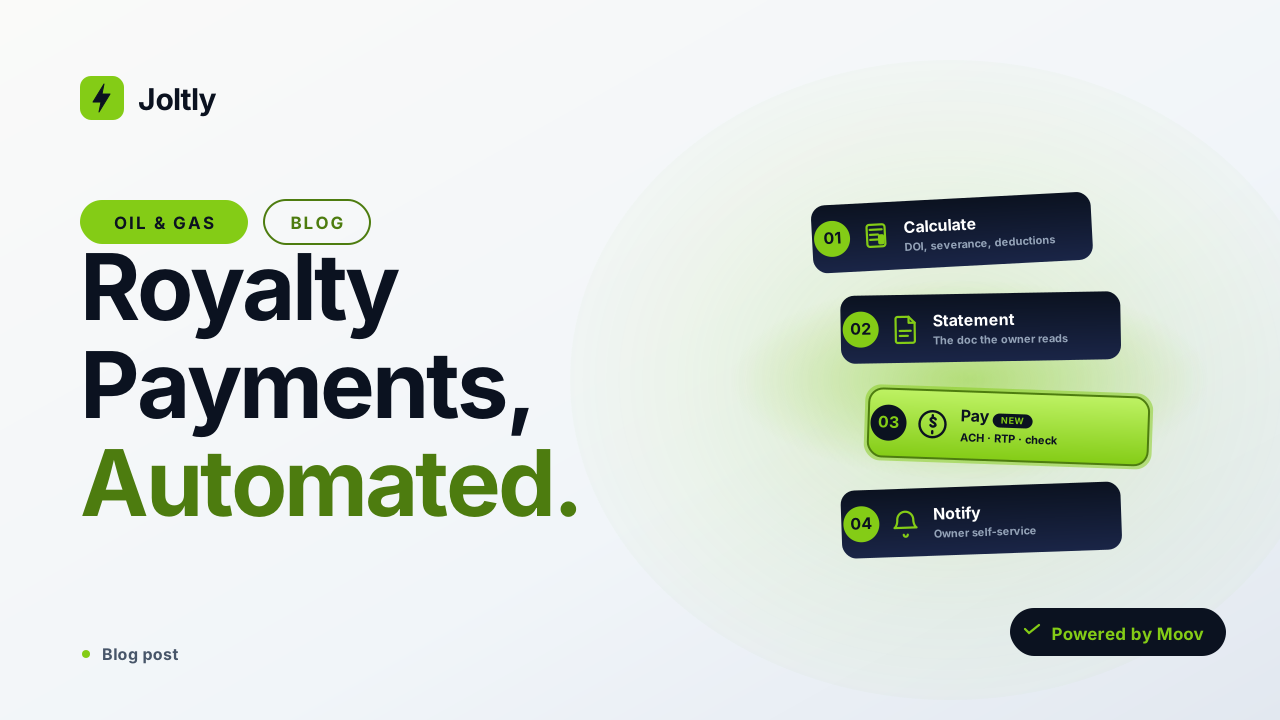
A modern revenue payments stack does four things, end to end. Most platforms only do the first two.
Run the DOI deck, apply severance and ad valorem per state, handle deductions, prior-period adjustments, and suspense. Output: net amounts per owner, per check date.
Generate the document that explains what the owner is being paid (and what was withheld and why). Most platforms do this well today.
Actually move the money — ACH for owners with bank info on file, RTP for instant settlement where supported, paper check for the holdouts. Tracked, reconciled, with a real audit trail. This is the layer that’s been missing.
Tell the owner the money is on the way. Let them log in, see the statement, see payment status, update their address, switch to ACH. Every self-service action is one fewer phone call.
When all four work together, a monthly pay run goes from a multi-day manual exercise to a one-click confirmation.
Joltly already handles layers 1, 2, and 4 for production accounting teams. The new piece — and the reason we’re writing this post — is layer 3. We’ve built it on top of Moov’s modern payments infrastructure, so a Joltly customer can run a revenue distribution and actually pay the owners — all from one place, with no bank file dance.
Move funds to owners with bank info on file using same-day ACH. No bank portal upload, no batch file gymnastics.
Real-time payments to supported banks — funds land in seconds, 24/7/365, certified directly with The Clearing House.
Owners enroll in ACH, update their address, and see payment status from a portal. Most “where’s my check” calls go away.
Get quick answers to common queries in our FAQs.


You only pay for what you use — no seat fees and no modules you don't need. Pricing is a monthly platform fee plus usage on documents processed, ACH payments, mailed checks, and the workflows you turn on. We size it to your actual monthly close so it scales with the work, not your headcount.
A smaller operator running 25 documents, 10 ACH payments, and 2 mailed checks a month would be priced on that exact volume. A larger operator at 100 documents, 50 ACH payments, and 10 checks pays predictably more. You always know what you're spending because it tracks the actual close.
Joltly connects directly to QuickBooks and Quorum On-Demand Accounting, and supports file-based export workflows for systems like PakEnergy and Integra. It manages accounts, items, vendors, partner mappings, JIB clearing, revenue liabilities, and netting accounts inside your existing setup.
Both sides of settlement. On expenses: invoice review, GL coding, approvals, JIB creation, ACH and check payments. On revenue: statement OCR, partner distributions, remittance emails, and netting between JIB receivables and revenue payouts — so your team replaces spreadsheet work and email follow-up during close.
Yes. Your wells, partners, revenue interests, GL mappings, approval flow, export formats, and partner-facing statements are configured per operator. Most customers go live on their existing chart of accounts and ERP setup — no rebuild required.
Faster than most teams expect. Your AP workflow can be live in less than a week — and you don't need to change your current accounting system. Revenue typically takes about two weeks. The only thing we need from you is a sample revenue statement so we can train the AI on your format.
We set up a Microsoft Teams channel or email channel for your team — whichever you prefer. You'll also get the founders' phone numbers for text messaging when you need a fast answer.