COPAS overhead in plain English: producing, drilling, and construction rates, and how to spot a double charge.
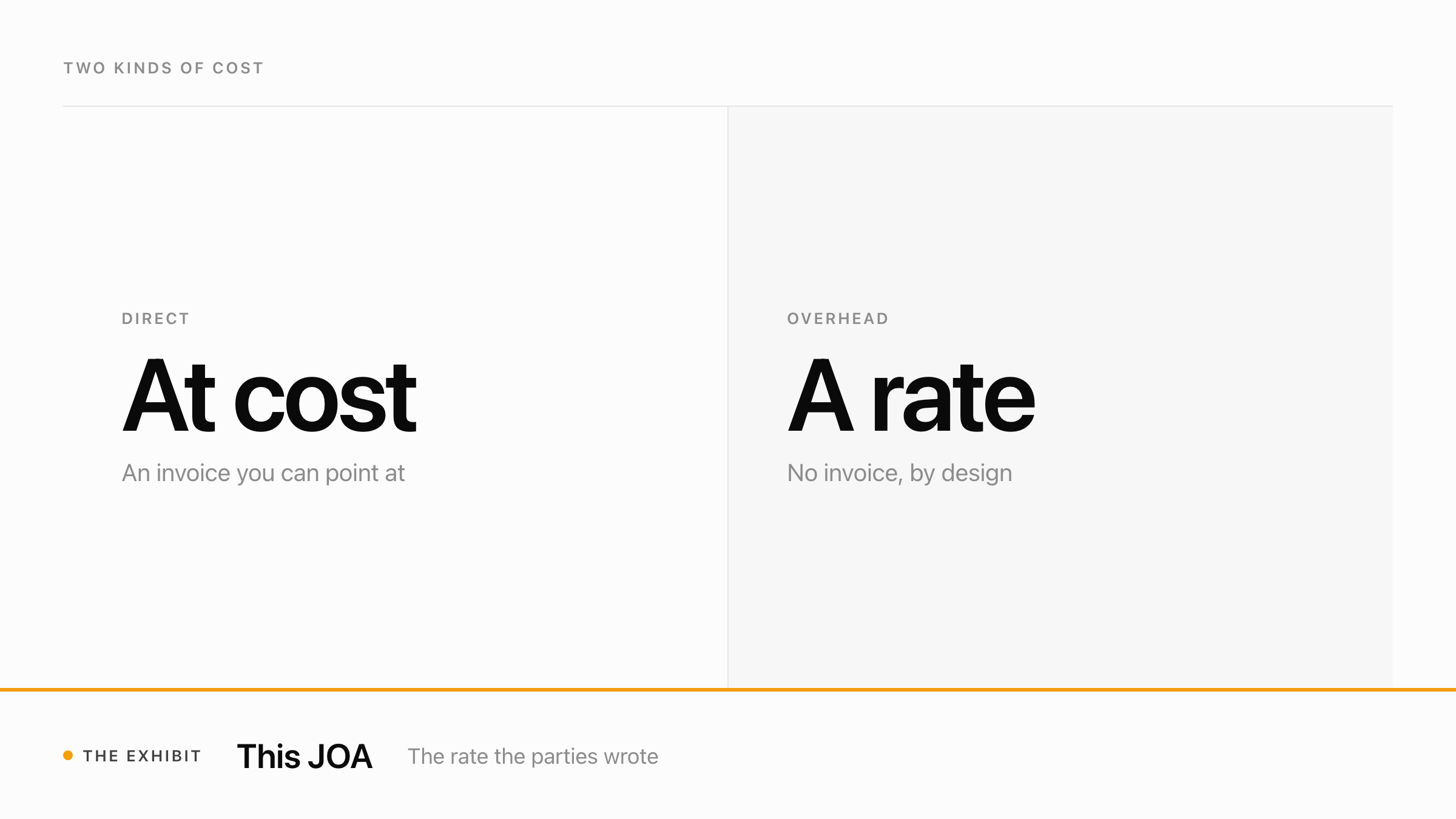


Overhead is the line on a joint interest billing that makes non-operators suspicious, because there is no invoice behind it. The operator calculated it. The support is not a vendor bill. The support is the accounting procedure attached to the joint operating agreement.
That procedure is the COPAS form the parties adopted, plus the rates they wrote into the exhibit. Overhead is how the operator gets paid for running the joint account — the indirect cost of supervision and the office — without sending each partner a piece of the Dallas rent.
Overhead is not a markup on the invoices. It is the charge for the costs that never become invoices.
Here is what the line is paying for, which rate you are looking at, and how to tell a fair one from a double charge.
The water hauler, the chemical, the pumping unit, the insurance premium allocated to the well. Billed to the joint account at cost. There is a document.
Producing, drilling, or construction. It covers the operator’s indirect cost of administering that well. There is no separate invoice, and there should not be one.
There is no industry-wide dollar amount. An old agreement may still be on a percentage. A current COPAS form is a fixed rate. Read the exhibit in front of you.
COPAS publishes model-form accounting procedures. The 1962 and 1974 forms billed overhead as a percentage of cost. Beginning with the later forms, and fully in the 2005 and 2022 forms, overhead is a fixed rate. Plenty of wells still produce under the old paper. The form named in your joint operating agreement is the one that governs, including an election the parties checked twenty years ago.
If the file does not contain the accounting procedure, you do not have an overhead rate. You have a number the operator has been using. Ask for the exhibit before you argue with the bill.
Applies while a well is drilling. Usually a rate per day, sometimes stated per well. It stops when drilling stops. Leaving it on through completion, or into the producing life, is a wrong bill.
A rate per producing well per month. This is the line on almost every monthly JIB. A shut-in well is often a different rate, or no rate, depending on the form. “We always charge it” is not the form.
For major surface work and projects that are not the drilling of a well. It is easy to charge producing overhead in the same month and call both of them normal. The exhibit says whether the construction rate replaces the producing rate or sits beside it.
This is the dispute that is actually about money. If the accounting procedure says the pumper, the foreman, or the district superintendent is covered by overhead, a separate “company labor” line for that person is a second bill for the same work. If the procedure says field labor is a direct charge, then it belongs on the JIB at cost, and it is not also inside the overhead rate.
The same test applies to district vehicles, a warehouse, and technical staff. One home. Either the invoice line or the rate. The election in the exhibit is the answer, and it was made when the agreement was signed, not when the JIB was prepared.
A line called “supervision” or “company labor,” plus producing overhead, with nobody able to point at the sentence that allows both.
A related-party trucking or roustabout charge billed as if it were a third-party vendor. The accounting procedure has rules for affiliates. Cost is not whatever the sister company invoiced.
An old percentage clause and a newer fixed rate both applied in the same month. One form is in force. The other is a habit.
Most fixed-rate procedures allow the overhead to move once a year with an index COPAS publishes. A producing rate of one number at signing becomes a different number five years later, and that is what the agreement asked for. It can also go the other way: the operator applies this year’s index to a rate that was never adjusted, or adjusts a rate the exhibit says is flat.
Keep the original rate, the adjustment clause, and the current billed rate on one line of a worksheet. When they disagree, the difference is the amount in dispute. You do not need a full audit to see it.
The non-operator books their share of overhead as a cost of the well, separate from LOE, so a change in the rate is visible. The operator does something different with the recovery. The partners’ share of overhead is income. It is not a reduction of lease operating expense. Cutting it back against LOE makes the well look cheaper to operate than it was, and it hides the overhead recovery inside an expense account nobody reviews.
On the JIB itself, overhead should be its own line: which rate, how many wells or days, and the amount. A summary called “miscellaneous” that happens to include it is not a joint interest billing. It is a request that nobody check.
Producing, drilling, and construction rates, calculated from the agreement and shown on the partner statement. The recovery posts as income, not as a quiet credit to LOE.
Get quick answers to common queries in our FAQs.


You only pay for what you use — no seat fees and no modules you don't need. Pricing is a monthly platform fee plus usage on documents processed, ACH payments, mailed checks, and the workflows you turn on. We size it to your actual monthly close so it scales with the work, not your headcount.
A smaller operator running 25 documents, 10 ACH payments, and 2 mailed checks a month would be priced on that exact volume. A larger operator at 100 documents, 50 ACH payments, and 10 checks pays predictably more. You always know what you're spending because it tracks the actual close.
Joltly connects directly to QuickBooks and Quorum On-Demand Accounting, and supports file-based export workflows for systems like PakEnergy and Integra. It manages accounts, items, vendors, partner mappings, JIB clearing, revenue liabilities, and netting accounts inside your existing setup.
Both sides of settlement. On expenses: invoice review, GL coding, approvals, JIB creation, ACH and check payments. On revenue: statement OCR, partner distributions, remittance emails, and netting between JIB receivables and revenue payouts — so your team replaces spreadsheet work and email follow-up during close.
Yes. Your wells, partners, revenue interests, GL mappings, approval flow, export formats, and partner-facing statements are configured per operator. Most customers go live on their existing chart of accounts and ERP setup — no rebuild required.
Faster than most teams expect. Your AP workflow can be live in less than a week — and you don't need to change your current accounting system. Revenue typically takes about two weeks. The only thing we need from you is a sample revenue statement so we can train the AI on your format.
We set up a Microsoft Teams channel or email channel for your team — whichever you prefer. You'll also get the founders' phone numbers for text messaging when you need a fast answer.